Organic by Tradition — Millet, Paddy & Kala Bhatt Farming in Hat Tharp
How around 100 hill families farm Hat Tharp's terraces without a drop of chemical fertiliser — the finger millet (mandua), paddy and black soybean (Kala Bhatt) that make the village organic by tradition.
Long before the word "organic farming" appeared on supermarket labels, the families of Hat Tharp were already living it — not as a premium choice, but as the only way they had ever known to grow food. This is the story of how a small Himalayan village feeds itself from hand-cut terraces, and why its traditional fields hold a lesson for the modern world.
Farming on a slope
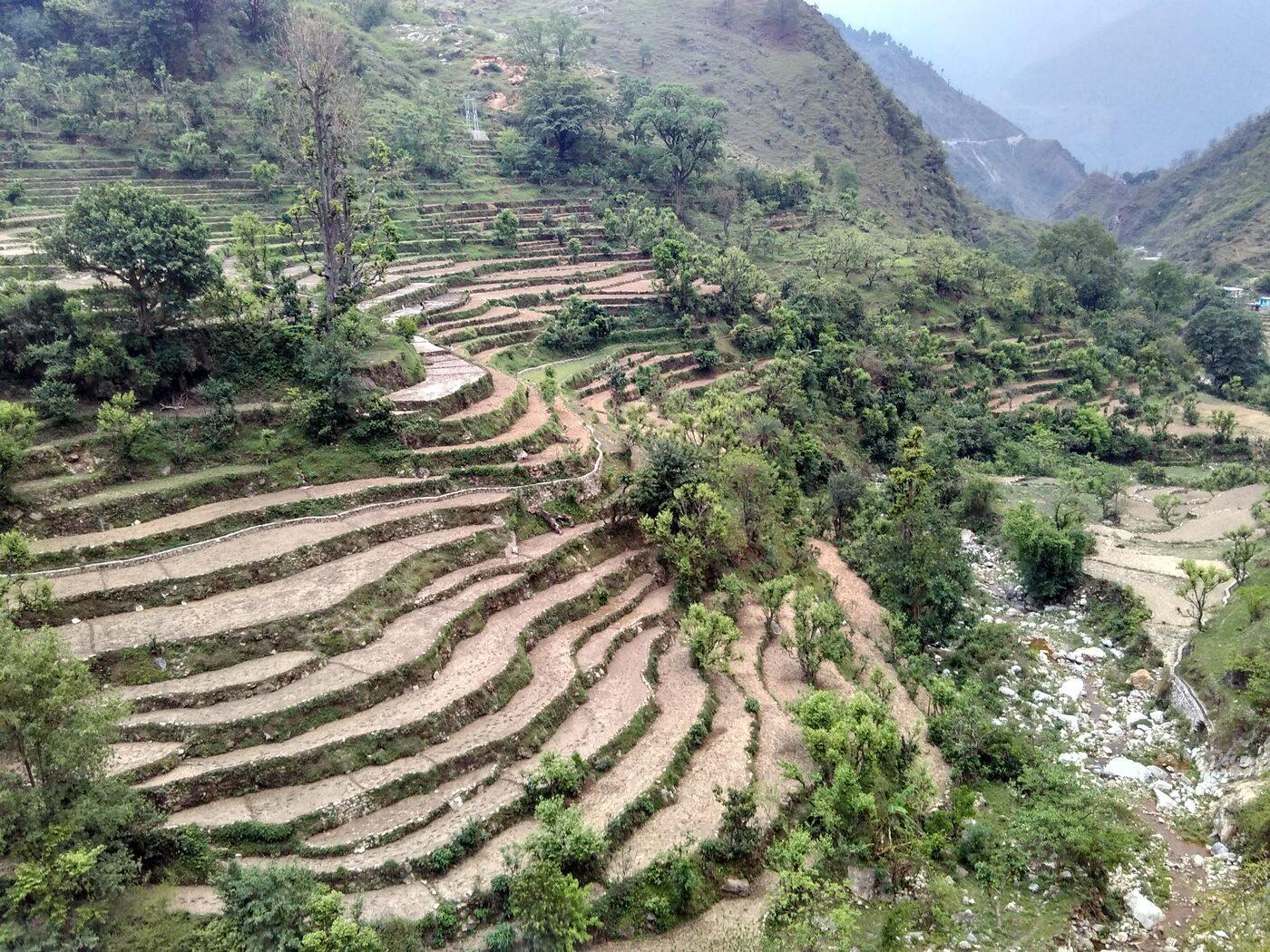
There is no flatland here to speak of. The village's 446.77 hectares climb and fold across the hillside, and farming means terraces — narrow steps carved into the slope and held in place by stone, generation after generation. Around 100 families work these fields, mostly as cultivators, in what the census records as a largely agrarian economy.
The crops that feed the hills
Hat Tharp's terraces grow a diverse, resilient mix of indigenous crops — exactly the kind of diversity that protects a community against a single bad season.
An indicative crop mix on the terraces
Diverse, drought-resistant indigenous staples
Source: Indicative proportions of traditional crops grown in Hat Tharp
- Finger millet (mandua / ragi): A hardy, drought-resistant grain that thrives at altitude and is a nutritional powerhouse — the backbone of the hill diet.
- Paddy: Grown on the wetter, irrigated terraces fed by the Charma river and the village springs.
- Kala Bhatt (black soybean): A prized local legume, rich in protein and the star of beloved Kumaoni dishes.
- Barley and wheat: Dependable winter staples that round out the year's harvest.
Why it is organic — by tradition, not by certificate
The fields of Hat Tharp are nourished with farmyard manure and sown with indigenous, farm-saved seed — not chemical fertilisers and hybrids trucked up from the plains. The result is food grown the way the hills have always grown it: in step with the soil, the forest and the seasons. The roughly 90% forest cover around the village keeps the springs flowing and the soil alive, closing a loop that industrial agriculture spends fortunes trying to recreate.
The money-order economy — and its quiet cost
There is a harder truth behind the beauty. Like much of Uttarakhand, Hat Tharp lives partly on the "money-order economy" — remittances sent home by family members who have migrated for work. With many young people away, farming often rests on the shoulders of women and elders. Understanding this is essential to understanding the village; you can explore the numbers in our demographics and economy pages.
From subsistence to carbon-smart
What was once simple subsistence is now, increasingly, a strategic strength. Organic terraces and protected forests make Hat Tharp a natural fit for its carbon-smart village journey — proof that tradition, treated with respect, can become the foundation of a genuinely sustainable future.
Taste it for yourself
Want to see the terraces, eat hand-grown millet and meet the families who farm them? Read how to reach Hat Tharp and contact the Gram Panchayat to arrange a farm-stay visit.