When the Walls Began to Speak: Hat Tharp's Garbage-Free Green Mission
On World Environment Day, Hat Tharp pledged to become a Garbage-Free Gram Panchayat — and turned its public walls into a daily reminder. Inside a Himalayan village's green awakening.
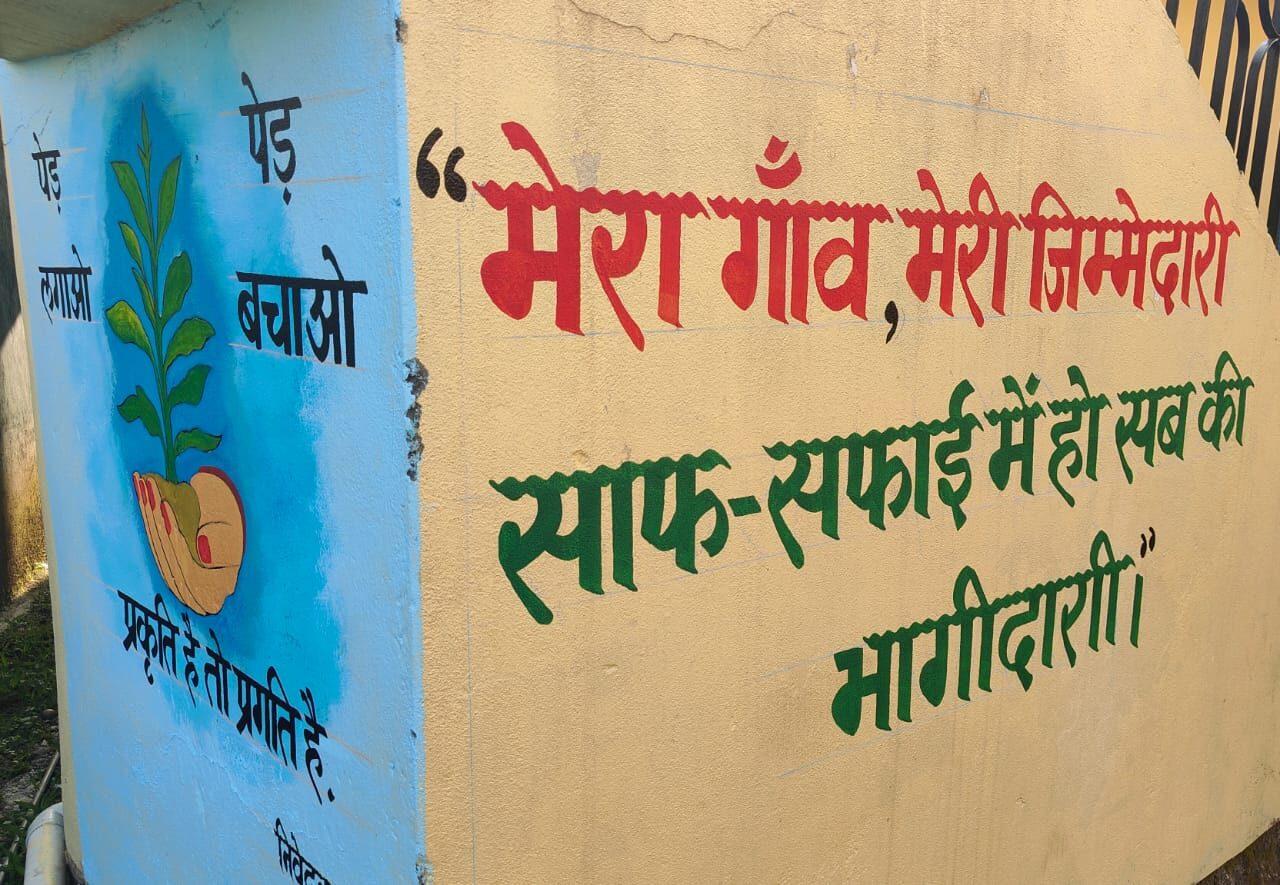
When you climb the last bend of the road into Hat Tharp, something unexpected greets you before the people do. The walls speak. Where there was once flaking plaster and the grey silence of cement, there are now rivers painted blue, forests painted green, and slogans that ask a simple, stubborn question: whose job is a clean village?
The answer the village has chosen is the boldest one possible — everyone's.
This is the story of how a small Himalayan gram panchayat in Didihat, Pithoragarh, turned its public walls into a classroom, its World Environment Day pledge into a daily habit, and its 459 residents into the front line of a quiet environmental movement. It is not a story about paint. It is a story about belief.
A pledge that refused to stay on paper
Every year, on World Environment Day (5 June), thousands of villages across India take a pledge. Most pledges fade by July. Hat Tharp decided its pledge would not.
On that day, under the leadership of Gram Pradhan Manoj Bhandari, the gram panchayat publicly committed to a single, measurable goal: to become a "Garbage-Free Gram Panchayat" (Kooda-Mukt Gram Panchayat). Not garbage-reduced. Not garbage-managed. Garbage-free.
It is an audacious target for any community, let alone one perched at roughly 1,725 metres in some of the most fragile terrain in the country. But the village understood something that policy documents often miss: a goal only becomes real when people can see it every single day. And so the campaign moved from the meeting hall to the most public surface available — the walls.
"Our aim was never simply to colour the walls," Pradhan Manoj Bhandari explained. "It was to develop, in every person's mind, a sense of responsibility towards cleanliness and the environment. The dream of a clean and green Hat Tharp will only come true through the participation of every villager."
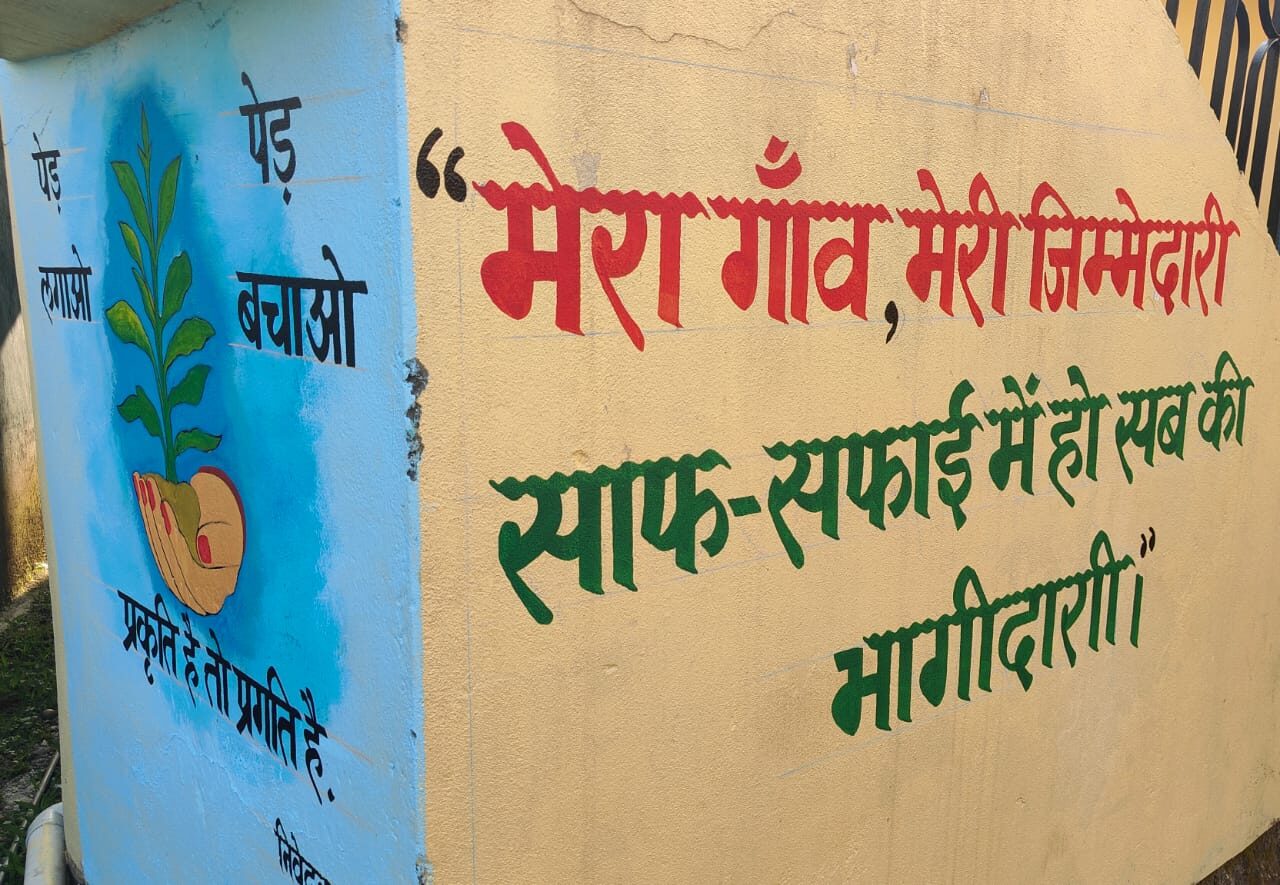
Why walls? The psychology of a visible promise
There is real behavioural science behind this choice, and it is worth understanding, because it explains why the campaign is working.
1. We act on what we are reminded of
Human beings are not short of good intentions — we are short of reminders. A pamphlet is read once and lost. A speech is heard once and forgotten. But a wall on the path to the fields, the temple, and the school is seen thousands of times a year. Each glance is a tiny nudge. Psychologists call this the mere-exposure effect: the more often we encounter an idea, the more natural and "ours" it begins to feel.
2. Public commitment is sticky
When a promise is private, breaking it costs nothing. When it is painted in colour on a shared wall, breaking it means looking your neighbours in the eye. Behavioural researchers call this the commitment and consistency principle — once a community publicly declares a value, its members work hard to act in line with it. Hat Tharp didn't just make a pledge; it made the pledge un-ignorable.
3. Beauty changes behaviour
There is a well-documented phenomenon in urban studies: people litter less in places that are already clean and cared-for. A broken, dirty wall invites neglect. A beautiful, painted wall invites respect. By making its public spaces beautiful, the village quietly raised the social cost of dirtying them.
What the campaign actually does
The wall-painting drive is the visible tip of a much larger, practical plan. Behind every painted slogan sits a real action the village is being asked to take.
- Source segregation — separating wet (kitchen, organic) waste from dry (plastic, paper, metal) waste at home, so that compostable matter never reaches a landfill and recyclables are recovered.
- Plastic reduction — cutting single-use plastic, carrying cloth bags to the Didihat market just two kilometres away, and refusing throwaway packaging.
- Tree plantation — turning the village's deep cultural love of trees into measured afforestation, especially of native broadleaf species that hold the soil and recharge springs.
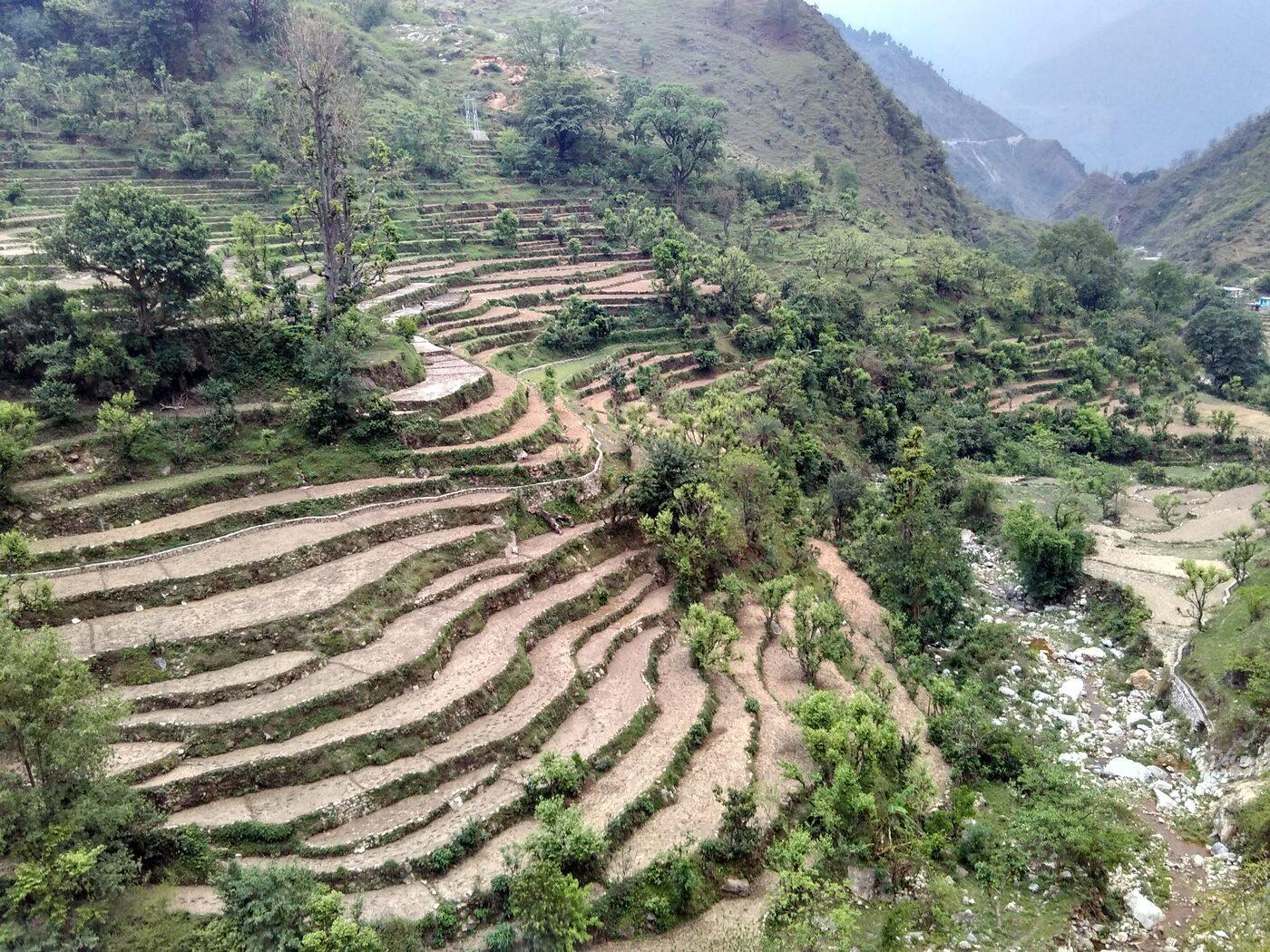
- Composting — converting kitchen and farm waste into organic manure for the very terraces that feed the village.
- Community shramdaan — voluntary collective labour to clean public paths, springs, and the banks of the sacred Charma River.
The river that started it all
You cannot understand Hat Tharp's obsession with cleanliness without understanding the Charma River — known locally and reverently as the Netra Dhara.
For generations, this river has been the village's lifeline: drinking water, irrigation for the terraced paddy, and a sacred presence woven into local belief. A garbage-free village is, at its heart, a promise to the river. Plastic that blows off a hillside ends up in the water. Waste dumped at the village edge eventually reaches the stream that everyone downstream depends on.
By framing waste segregation not as a government chore but as an act of devotion to the Netra Dhara, the campaign taps into something far more powerful than any fine or regulation: reverence. In Hat Tharp, ecology has always been a form of faith.
A village that was already built to lead
Here is what makes this initiative more than hopeful — Hat Tharp has the human capital to pull it off.
| Indicator | Hat Tharp | What it means |
|---|---|---|
| Literacy rate | 91.27% | Far above the rural Indian average — messages land and spread fast |
| Female literacy | 86.18% | Women, who manage most household waste, can lead the change |
| Sex ratio | 1,115 women per 1,000 men | A community where women's voices carry real weight |
| Households | 114 | Small enough for every single home to be reached personally |
| Population | 459 | A scale where 100% participation is genuinely achievable |
A campaign like this would drown in a city of millions. In a village of 114 households, every home can be visited, every family can be heard, and "100% participation" is not a slogan — it is arithmetic.
This is the hidden advantage of the small Himalayan village: change here is not a statistic. It is personal.
A village built to lead
Literacy in Hat Tharp compared with the Uttarakhand average
Source: Census of India 2011
From cleanliness to carbon-smart
The garbage-free mission is the first visible chapter of a much larger ambition — Hat Tharp's journey to become a Carbon-Smart Heritage Village. Waste, after all, is carbon. Rotting organic garbage releases methane. Burnt plastic poisons the air. Every kilogram of waste composted instead of dumped, every tree planted, every plastic bag refused, is a small subtraction from the village's carbon footprint.
The walls of Hat Tharp are, in this sense, the opening lines of a climate story being written by an entire community — not in a distant capital, but on the path between the school and the fields.
What you can learn from a village of 459 people
It would be easy to read this as a charming local story and move on. That would be a mistake. Hat Tharp is quietly demonstrating principles that scale to any community on earth:
- Make the invisible visible. A goal you can see every day is a goal you will act on.
- Turn duty into identity. People protect what they feel is theirs and sacred, not what they are merely told to do.
- Start where participation is possible. Begin at a scale where every individual matters, then grow.
- Lead from the front. When the Pradhan paints alongside the villagers, the message is not "you should" — it is "we are."
Frequently asked questions
What is a "Garbage-Free Gram Panchayat"? It is a village that prevents, segregates, composts, and recycles its waste so that little or no garbage reaches open dumps or waterways. Hat Tharp adopted this as a formal goal on World Environment Day under Pradhan Manoj Bhandari.
Is the wall-painting just decoration? No. The paintings are public reminders attached to real actions — source segregation, plastic reduction, composting, and tree plantation. Their job is to keep the goal alive in everyone's mind every day.
How can I support or visit? Hat Tharp welcomes visitors, volunteers, and well-wishers. You can reach the Gram Panchayat office at +91 98737 51617 or write to admin@villagehat.in.
The walls are only the beginning
Paint fades. That is the honest truth. But the habits a community builds while the paint is fresh do not. If a child in Hat Tharp grows up walking past a wall that says the Earth is ours to protect — and watches her parents segregate waste, plant trees, and keep the Charma clean — then the most important painting will not be on the wall at all.
It will be in her mind.
And that is a village's surest investment in its own future. Hat Tharp has made it. The walls have begun to speak — and an entire community has decided to listen.