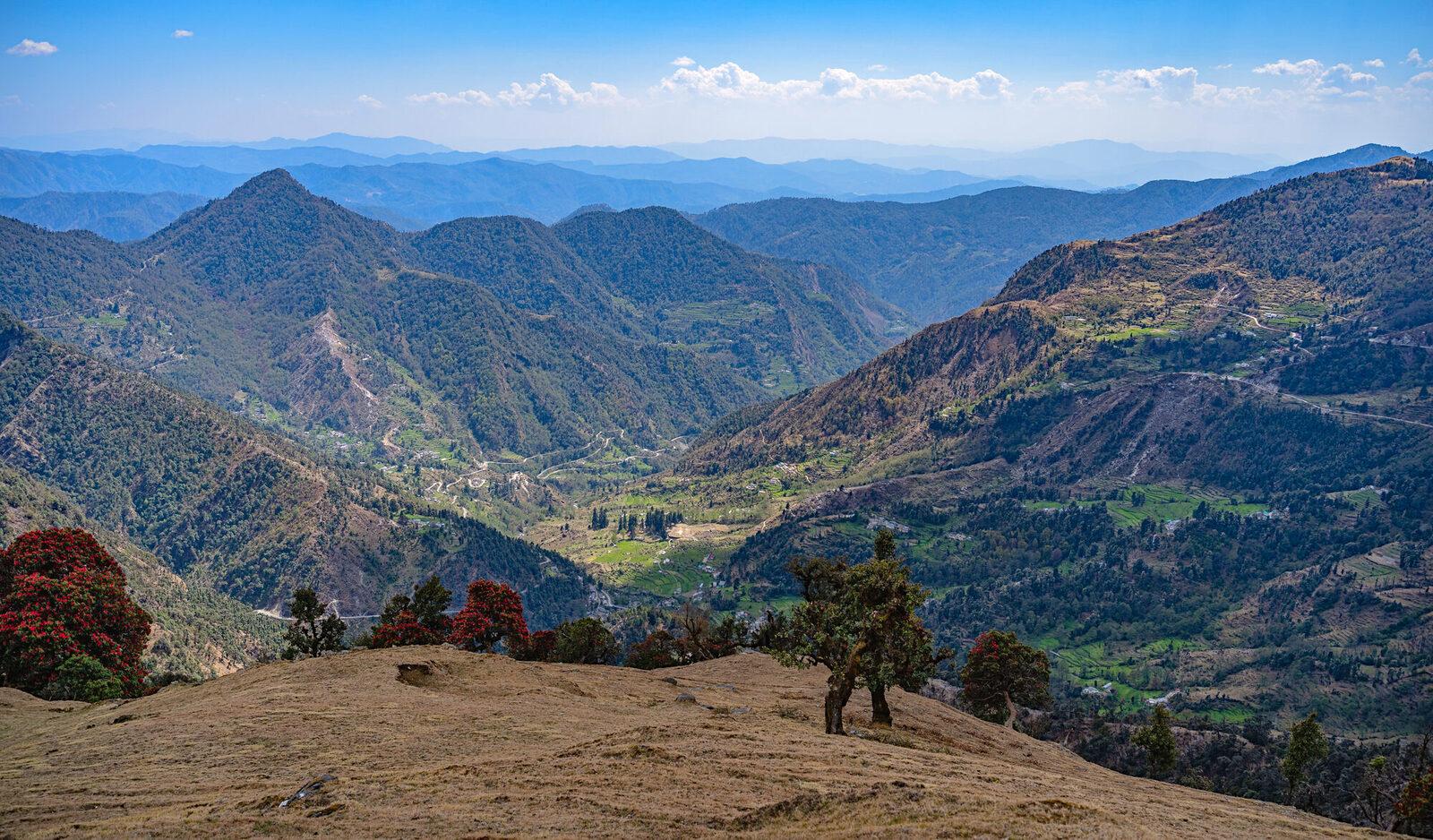
Transforming Hat Tharp into a low-carbon, resilient community
Pairing a centuries-old tradition of sacred-forest stewardship with modern clean technology.
Our Carbon-Smart Vision
Transforming Hat Tharp into a self-sustaining, low-carbon, resilient community.
Hat Tharp already protects nearly 90% of its land as community-conserved forest — an indigenous eco-theological practice in which forests are dedicated to local deities and guarded by villagers themselves. Our vision builds on this living tradition: to pair centuries-old stewardship with modern clean technology and become a recognised Carbon-Smart Village.
Five Pillars of Action
- Solar Energy — rooftop and street solar to cut diesel/grid carbon and secure power through harsh winters.
- Rainwater Harvesting — recharge structures and storage to reduce pressure on the Charma and buffer against erratic monsoons.
- Organic Terrace Farming — scaling our indigenous, drought-resistant seeds (Madua, Bhatt, Kala Bhatt) and chemical-free cultivation.
- Sacred Forest Conservation — formalising and expanding community afforestation around our deity-dedicated forests.
- Waste Segregation — stopping the flow of solid waste and sewage into the Charma river through village-level collection and composting.
Our National Benchmark — Modhera
We are realistic about where we stand: Hat Tharp is at the starting phase of its carbon-smart journey, and we are learning from those who have led the way.
Our benchmark is Modhera in Gujarat — officially India's first 'solar village'. Modhera meets 100% of its electricity needs from a 6 MW solar plant with 15 MWh of battery storage, with rooftop systems on roughly 1,300 of its 1,600 homes, under a ₹65-crore central-and-state project. It proves that an Indian village can run on the sun.
Hat Tharp aspires to adapt this model to the Himalayas — to our slopes, our terraces and our traditions — step by careful step.
Why We Are Not Starting From Zero
Our greatest carbon asset is already in place. Through an indigenous practice of dedicating forests to local deities, the community has kept nearly 90% of the village's land under forest cover — sequestering carbon, protecting springs and sheltering wildlife long before the word carbon-smart existed.
Add to this our organic terraces, our 91.27% literacy, and a culture of discipline drawn from generations of military and government service, and Hat Tharp begins this transition from a position of genuine strength.
Our carbon-smart numbers
Live targets and achievements, updatable by the Gram Panchayat from the admin panel.
0%
Community Forest Cover
0+
Trees Under Protection
0
Organic Farming Families
0
Homes Targeted for Solar
0+
Indigenous Crop Varieties
0tonnes
Annual CO₂ Avoided (target)
The initiatives powering our transition
Solar-Powered Village
Rooftop and street solar lighting to cut grid/diesel dependence and secure power through harsh Himalayan winters.
Rainwater Harvesting
Recharge pits and storage tanks to replenish springs, ease pressure on the Charma and buffer erratic monsoons.
Organic Terrace Farming
Scaling chemical-free cultivation of drought-resistant indigenous seeds — Madua, Bhatt and Kala Bhatt — across ~100 farming families.
Sacred Forest Conservation
Formalising and expanding the community's deity-dedicated forests that already cover ~90% of village land.
Waste Segregation & Composting
Door-to-door dry/wet segregation and composting to stop solid waste and sewage from polluting the Charma river.
Support the carbon-smart transition
Our forests are guarded by villagers, our terraces tended by hand, and our future built by community effort. Researchers, government partners, the diaspora and well-wishers can all play a part — through afforestation drives, solar and rainwater projects, or simply by visiting and sharing our story.
Get in touch
- admin@villagehat.in
- +91 98737 51617
Gram Panchayat Hat Tharp, Didihat, Pithoragarh, Uttarakhand 262551
Carbon-Smart Hat Tharp — FAQs
How a small Himalayan village is building a low-carbon, climate-resilient future — explained.
What does 'carbon-smart village' mean for Hat Tharp?
It is a community-led plan to keep the village low-carbon and climate-resilient — combining its traditionally organic terraces, community-protected forests, solar lighting, rainwater harvesting and waste segregation. This is an early, growing phase planned by the Gram Panchayat.
What carbon-smart initiatives are under way?
Solar street and home lighting, rainwater harvesting, organic farming with indigenous seeds, sacred-forest conservation, tree plantation and household waste segregation — rolled out in phases by the Panchayat.
How much of the land is forest?
Roughly 90% of the land around the village is forest, protected for generations through the local sacred-forest custom of dedicating groves to village deities — a living example of eco-theology.
Is the farming really organic?
Hat Tharp's terraces have been largely organic by tradition, growing paddy, finger millet (mandua), barley, wheat and the prized Kala Bhatt (black soybean) with minimal chemical input.
Who leads the carbon-smart programme?
It is planned and led by the Gram Panchayat under Gram Pradhan Mr. Manoj Bhandari, with active participation from village households.
How can I support the initiative?
You can connect with the Panchayat at +91 98737 51617 or admin@villagehat.in to support afforestation, solar lighting and clean-water efforts.