Hiran Chital & the Oldest Ramlila of Didihat
From the village's own Hiran Chital celebration to one of the oldest Ramlilas in Didihat — how Hat Tharp keeps its culture, faith, and festivals alive.
When the monsoon mist lifts off the Haat Valley and the paddy turns from green to gold, Hat Tharp begins to sing. The drums come out. The masks are dusted off. The old songs, half-remembered all year, return to every tongue. For in these hills, a festival is never just an event — it is the village remembering who it is.
This is the story of how a small Himalayan village keeps its culture alive: through the beloved Hiran Chital celebration, through one of the oldest Ramlilas in the Didihat region, and through the food, faith, and festivity that turn 459 people into one community.
A culture that performs itself
To outsiders, the festivals of Kumaon can look like simple celebration. They are far more than that. In a village without museums or archives, the festival is the library. It is how history is stored, how values are taught, and how each generation hands the culture to the next — not in books, but in the body: in dance, in song, in shared ritual.
Hat Tharp's festive calendar is its living heritage, performed anew each year. And two traditions stand at its heart.
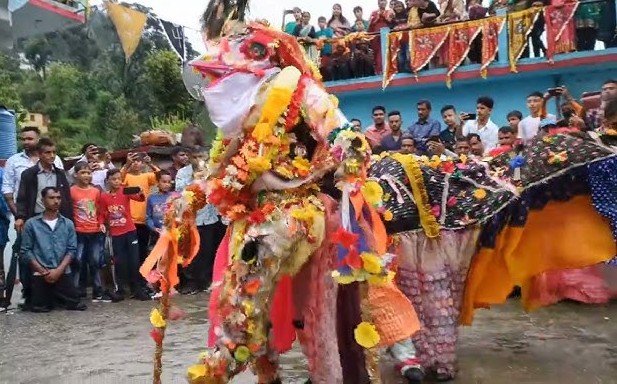
Hiran Chital: the village's own celebration
Among all the festivals of the region, Hiran Chital holds a special place in Hat Tharp — a distinctive seasonal celebration that binds the community to its land and its seasons.
The name itself — evoking the hiran (deer) and the chital (spotted deer) — carries the memory of a time when village life and forest life were inseparable, when the rhythms of the wild animals and the rhythms of the harvest were read as one calendar. To celebrate Hiran Chital is to honour that ancient bond between the people of Hat Tharp and the forests that surround them.
It is the kind of festival you will not find in a tourist brochure or a national calendar. It belongs to this community, in this valley — a piece of intangible heritage as precious and as local as the spring water and the slate roofs. In an age when culture is increasingly mass-produced and identical from city to city, a festival that belongs to one village alone is a quiet act of resistance.
The Ramlila: a thousand nights of the Ramayana
If Hiran Chital is the village's intimate secret, the Ramlila is its grand public theatre — and Hat Tharp is proud to host one of the oldest Ramlilas in the entire Didihat region.
The Ramlila — the dramatic re-enactment of the life of Lord Rama, drawn from the Ramayana — is performed across northern India. But each one carries the flavour of its place, and the Kumaoni Ramlila has a character all its own: a distinctive musical style, blending dialogue, song, and devotion across many nights of performance.
For a village to sustain one of the oldest Ramlilas in its region is no small thing. It means an unbroken chain of:
- Performers — villagers, often the same families across generations, who learn the roles, the songs, and the staging.
- Musicians — keepers of the specific ragas and rhythms that make a Kumaoni Ramlila instantly recognisable.
- Audiences — the whole community, gathering night after night, passing the tradition forward simply by showing up.
When the boy who once watched the Ramlila grows up to play Rama, and then teaches his own son the part, the festival becomes a river of memory flowing through the generations. That is what Hat Tharp has kept alive.
"The Ramlila is not a show we put on for others," says Gram Pradhan Manoj Bhandari. "It is how our children learn the values of dharma, courage, and devotion — not from a screen, but from their own neighbours standing on the stage. When we keep these traditions alive, we keep the village's soul alive."
The taste of the festival: Khaichua
No Kumaoni celebration is complete without its food, and Hat Tharp has a sweet that belongs to its festive table: Khaichua, a traditional delicacy made from khoya (reduced milk solids).
Food, in a village like this, is never just nourishment. A festive sweet like Khaichua is:
- a marker of occasion, distinguishing a feast day from an ordinary one,
- a bond of hospitality, shared with guests, neighbours, and returning family,
- and a recipe of memory, carrying the taste of childhood and home for every villager who has migrated to a distant city and dreams of the hills.
To eat Khaichua during a Hat Tharp festival is to taste the place itself.
Why festivals are the village's survival strategy
It is easy to view festivals as pleasant but unimportant — the decoration on the cake of "real" development. Hat Tharp understands the opposite is true. In a hill village facing out-migration, festivals are infrastructure for belonging.
They bring the diaspora home
The festive calendar is when the migrant sons and daughters return. Hiran Chital, the Ramlila, the harvest celebrations — these are the magnets that pull a scattered community back to its centre, renewing ties that remittances alone cannot sustain.
They transmit values without a classroom
Watch a Ramlila and you are watching an entire ethical education — about duty, sacrifice, loyalty, and courage — delivered as gripping live drama. The festival teaches what no textbook can: values felt, not just read.
They build the social trust that everything else needs
The garbage-free mission, the carbon-smart farming, the tree-planting on Harela — none of these work without a community that trusts and cooperates. And nothing builds that trust like a village that sings, performs, cooks, and worships together, year after year. Festivals are where the social fabric is woven.
Culture as the foundation of the future
Here is the insight at the heart of Hat Tharp's story. A village can have solar panels and waste systems and rainwater tanks, but if its people scatter and its identity dissolves, there will be no one left to switch the lights on.
Culture is what makes a place worth saving — and worth staying in. The festivals of Hat Tharp are not a distraction from its carbon-smart future. They are its emotional engine — the reason the community holds together, the reason its children may choose to return, and the reason the whole ambitious project has a soul.
A people who still perform their oldest Ramlila, still celebrate their own Hiran Chital, and still share their Khaichua are a people who know who they are. And a community that knows who it is can build almost anything.
Come and join the celebration
The festivals of Hat Tharp are not staged for outsiders — but visitors who come with respect are welcomed warmly into the circle. To witness a Kumaoni Ramlila under the night sky, to share a festive meal, to feel the drums in your chest as the whole village celebrates together, is to understand the hills in a way no trek ever could.
If you wish to experience Hat Tharp's living culture, or to time a visit with the festive season, reach the Gram Panchayat at +91 98737 51617 or admin@villagehat.in.
The song that does not end
Empires faded and trade routes closed, but the songs of Hat Tharp never stopped. Each year the drums return, the Ramlila lamps are lit, the Khaichua is shared, and a village of 459 souls becomes, for a few luminous nights, a single beating heart.
That is the real wealth of this place — not counted in rupees or carbon credits, but in the unbroken music of a community that has never forgotten how to celebrate itself. And as long as that song continues, Hat Tharp will endure.